
AI + Art = Updates
Art and technology go hand in glove. Traditionally, art was the glove we saw and admired, while tech was the hidden hand. But times have changed. Art has been updated.
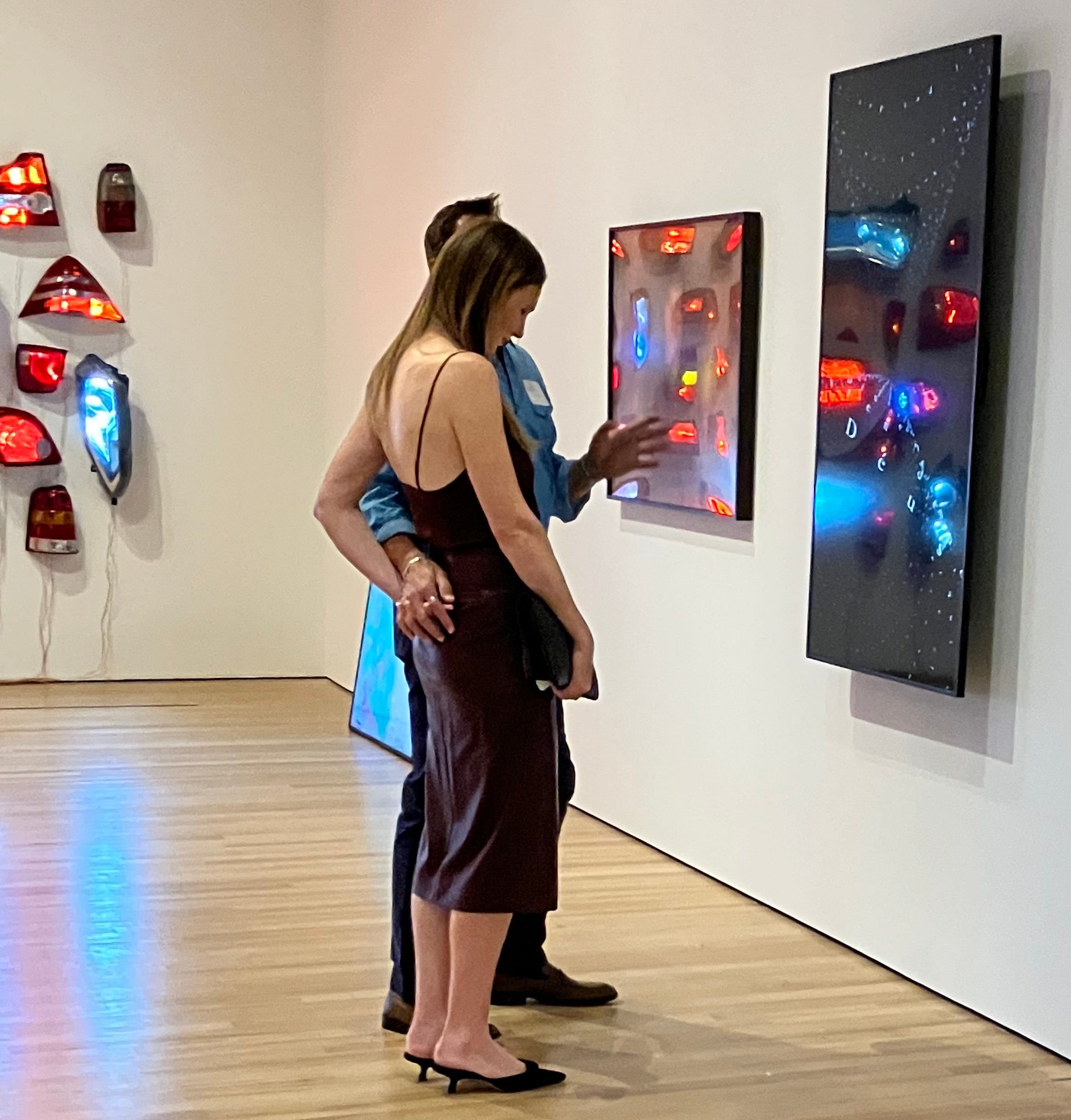
If you’re lucky enough to be in Austin, Texas, now through August 2, 2026, The Blanton Museum of Art is hosting Run the Code: Data Driven Art.
In my opinion, this exhibit stands out for three reasons.
The first reason is the artwork.
Drawn from Carl and Marilynn Thoma’s extensive collection of digital and media art (1960 to present), Run the Code features many of the movement’s sharpest minds. Refik Anadol, teamLab, Jennifer Steinkamp, and Leo Villareal, to name a few.
The second reason - the curators. Hannah Klemm, the Blanton’s curator of Modern and Contemporary Art, co-curated the exhibition with Kathleen Forde, the Thoma Foundation’s curator. Both women know the art well and are experienced at mounting museum shows, but with limited gallery space and so much good art to choose from, the selection task was daunting. Klemm explains how she organized the exhibit.
“I was especially interested in how artists are using algorithms in very different ways, from conceptual concerns to creating new visual experiences.”


“As the checklist began to take shape, a set of shared concerns started to emerge quite naturally. Each section highlights a different way artists engage with code—the sections being interactivity, data visualization, art history, landscape, and technological obsolescence.
I needed each artwork to really bring something to life for the visitor… and things that draw us in as curators we hope really draw in audiences as well!”
To give you a sense of what you’ll experience, I’ll describe a few pieces from the Landscape section.
Refik Anadol’s Machine Hallucinations – Study 1 is a framed screen of Gothic cathedrals that continually updates. The images are generated by a database containing pictures of hundreds of thousands of real cathedrals, which a neural network reconfigures into new forms. The emerging structures that randomly materialize, then quickly dematerialize, don’t actually exist. Even so, viewers stand hypnotized by these ornamental “hallucinations. And, on reflection, by what they reveal - the limitless potential of the human imagination.


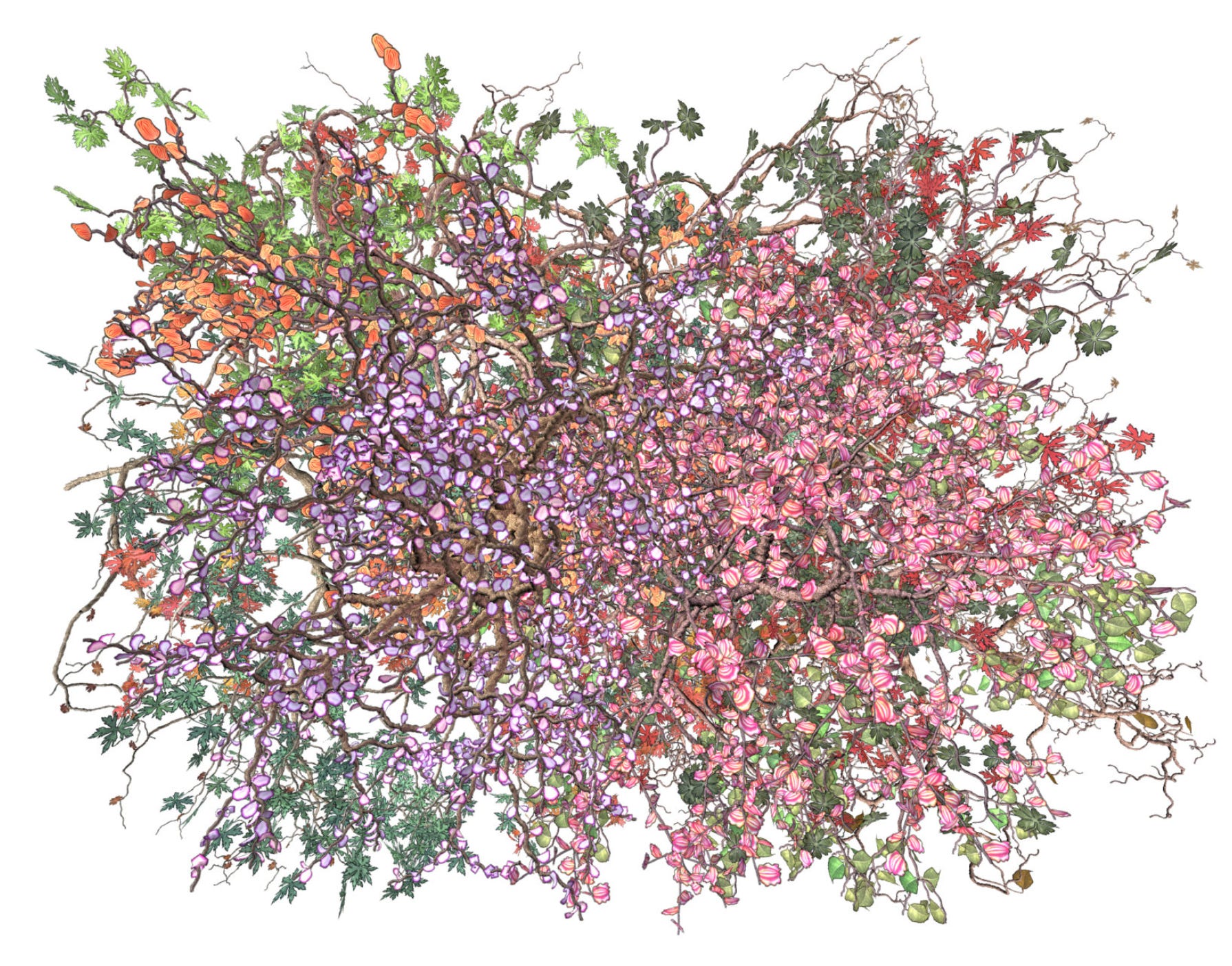
Around the corner, Jennifer Steinkamp’s wall-sized flower bouquet writhes and wilts in an endless seasonal swirl of blossoms, vines, leaves, and rot. Titled Bouquet 1, the projected image uses animation and generative processing to produce an enchanting, ever-changing mirage. Flowers in art have long symbolized life and death. Yet, Steinkamp’s garden never dies, because it owes its life to technology.
Marina Zurkow’s framed screen Mesocosm (Wink, TX) features a graphic landscape with a sinkhole at its center. The piece functions like a window. We “stare out” and see clouds rolling by, butterflies migrating, days and nights, new road signs, tumbleweeds, people in hazmat suits, and the sinkhole filling and draining. But what are we really looking at?
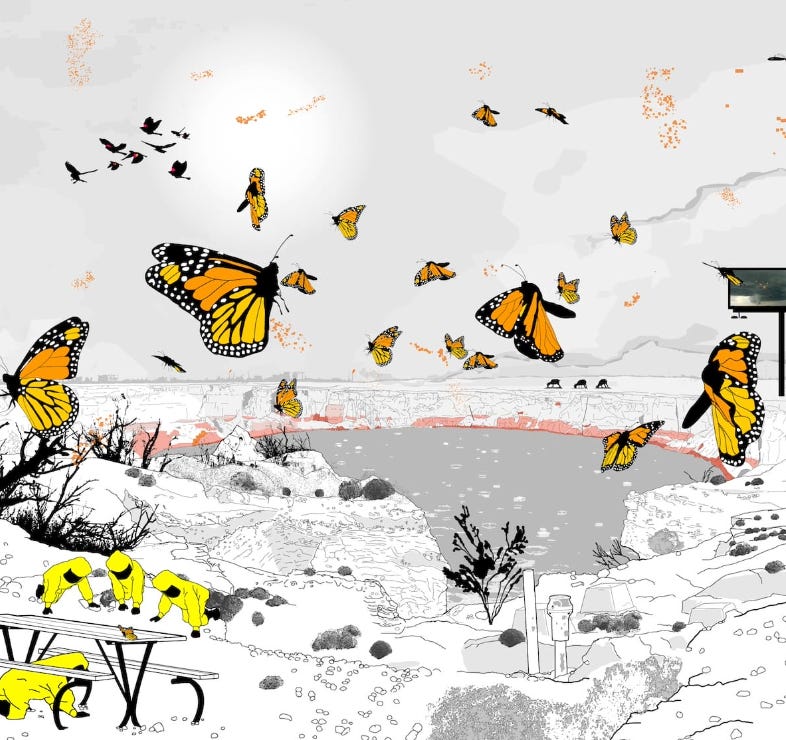
For the longest time, artworks were still or, in the case of videos, a repetitive loop. Those images provided a stable, yet false, sense of reality. With generative images, like Mesocosm, change is the only constant.
There is a prophetic quality at work in many of the pieces on display. We aren’t just seeing cleaver, conceptual images, we’re seeing a new vision of life in the Age of AI.
As I wandered the galleries, I saw and participated in several spontaneous conversations with strangers. Wowed, confused, or shaken by the work, we were swept up and united by the newness of it all, and we eagerly shared our impressions. That, to me, is the sign of curatorial success.
The third reason to see this show is the adjacent exhibition, American Modernism from Charles Butt’s collection: From Edward Hopper to Alma Thomas.
Blanton’s Chief Curator, Carter E. Foster, arranged the exhibit. His entrance wall features a dozen or so paintings, tightly hung in the salon style. Together they convey the collector’s aesthetic passion, while also highlighting the wide range of styles these American abstract artists were developing, in some cases simultaneously, in the early decades of the 20th century.


Art history tends to focus on leading movements. Butt, however, was a self-taught art connoisseur with an affinity for the lives of “ordinary” people. The art of iconoclasts also caught Butt’s eye, and he collected several of them in depth. And he acquired paintings that convey the excitement of pioneering artists as they explored entirely new ideas, such as cubism and abstraction.
Seen together, these adjoining exhibits function like a time machine, transporting us from the early 20th to the early 21st century. Both shows feature poignant collections amassed by innovative collectors. As you walk through the galleries, you can literally see art history updating as these daring artists respond to life’s changing conditions by inventing new ways to create, record, and expand the human experience.
Blanton Museum of Art - 200 E. Martin Luther King Jr. Blvd, Austin, https://blantonmuseum.org
Many thanks for highlighting this exhibit Julia! I will definitely check it out.